
⚡ Quick Answer
Startup marketing often feels chaotic because founders lack a shared diagnostic framework to evaluate what marketing is actually solving. The Marketing Plate breaks every marketing activity into four groups: Veggies (Foundation) — positioning and ICP clarity; Proteins (Support) — CRM, systems, and handoffs; Carbs (Fuel) — campaigns, SEO, and paid media; and Herbs & Spices (Differentiation) — brand, storytelling, and memorability.
Most startups overfocus on Carbs. If traffic is coming in but leads are weak, check your Veggies. If leads arrive but nothing converts, check your Proteins. If nobody notices you at all, check your Carbs. If people notice but don’t choose you, check your Herbs & Spices.
The one question to ask before approving any marketing work: Which part of the plate is weakest right now — and what metric should move if we fix it?
📖 In this article
- How to tell which part of your Marketing Plate is weak
- 🥦 Veggies = Foundation — positioning, ICP, value proposition
- 🍗 Proteins = Support — CRM, systems, team handoffs
- 🍞 Carbs = Fuel — SEO, paid, campaigns, conversion
- 🌿 Herbs & Spices = Differentiation — brand, story, memorability
- 5 questions to ask before approving more marketing work
- What founders should realistically expect from marketing
- What founders should not expect from marketing
- A simple founder recipe (90-day focus)
At some point, startup marketing starts sounding like a kitchen with too many cooks:
The SEO agency wants more content.
The social media expert wants more consistency.
The paid specialist wants more budget.
The brand person wants sharper positioning.
The founder reads a few articles, opens too many tabs, and ends up with twelve opinions and no recipe.
This is where founders start losing trust in marketing.
Not because marketing is useless.
Because it is often presented as a pile of disconnected activities instead of a system.
And when you do not come from a marketing background, it becomes very hard to tell:
What are we actually solving?
What should marketing do?
What can it influence?
What should I realistically expect?
That is the real gap.
So instead of adding another layer of tactics, let’s make marketing easier to diagnose.
The Marketing Plate is not just a metaphor. It is a diagnostic tool.
I use the Marketing Plate because founders do not need another giant framework with ten arrows and a strategy workshop attached to it.
They need a way to tell where growth is actually getting stuck.
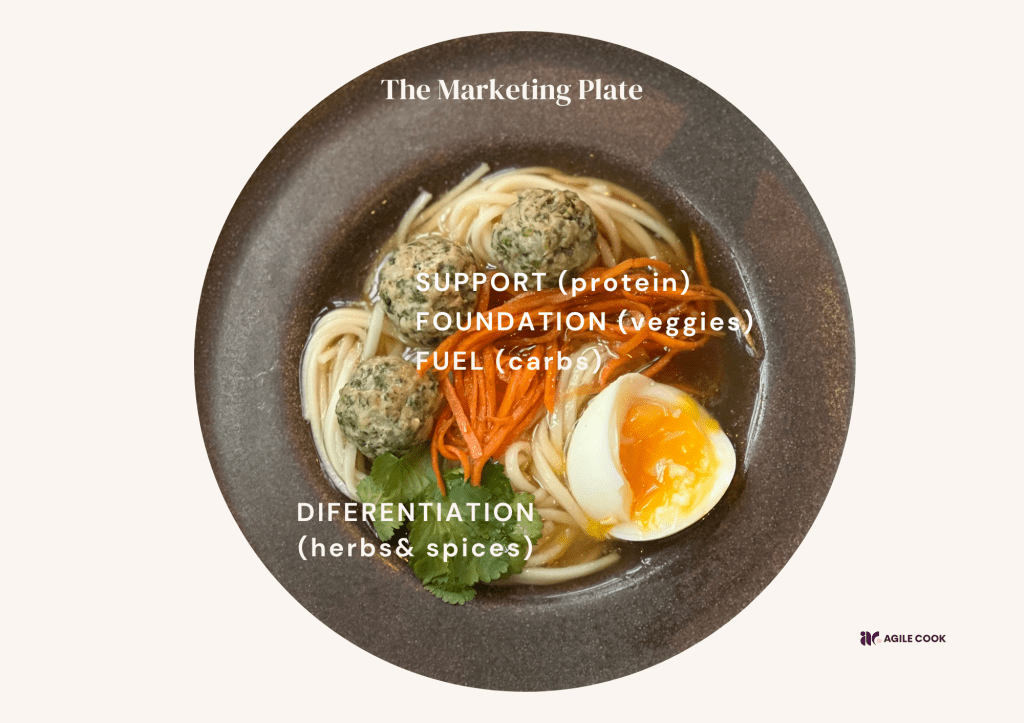
The plate has four parts:
Veggies = Foundation
Who you help, what problem you solve, how clearly you are positioned.
Proteins = Support
The systems, team, handoffs, tracking, and structure that make growth repeatable.
Carbs = Fuel
The visible activity: SEO, paid, content, social, campaigns, landing pages, outbound.
Herbs & Spices = Differentiation
What makes you memorable, trustworthy, easier to choose, and harder to confuse with everyone else: tone of voice, storytelling, experience design.
Most startups overfocus on the carbs.
More posts.
More campaigns.
More content.
More visibility.
But if the veggies are weak and the proteins are shaky, you are not scaling.
You are paying to amplify confusion.
How to tell which part of your Marketing Plate is weak
Here is the simplest version.
If traffic is coming in but leads are weak, check the Veggies.
If leads are coming in but nothing moves, check the Proteins.
If nothing is happening at all, check the Carbs.
If people notice you but do not remember or choose you, check the Herbs & Spices.
Now let’s go section by section.
Veggies = Foundation
What this part does
This is where marketing helps define who you serve, what problem you solve, why people should care, and why they should choose you.
This is your clarity layer.
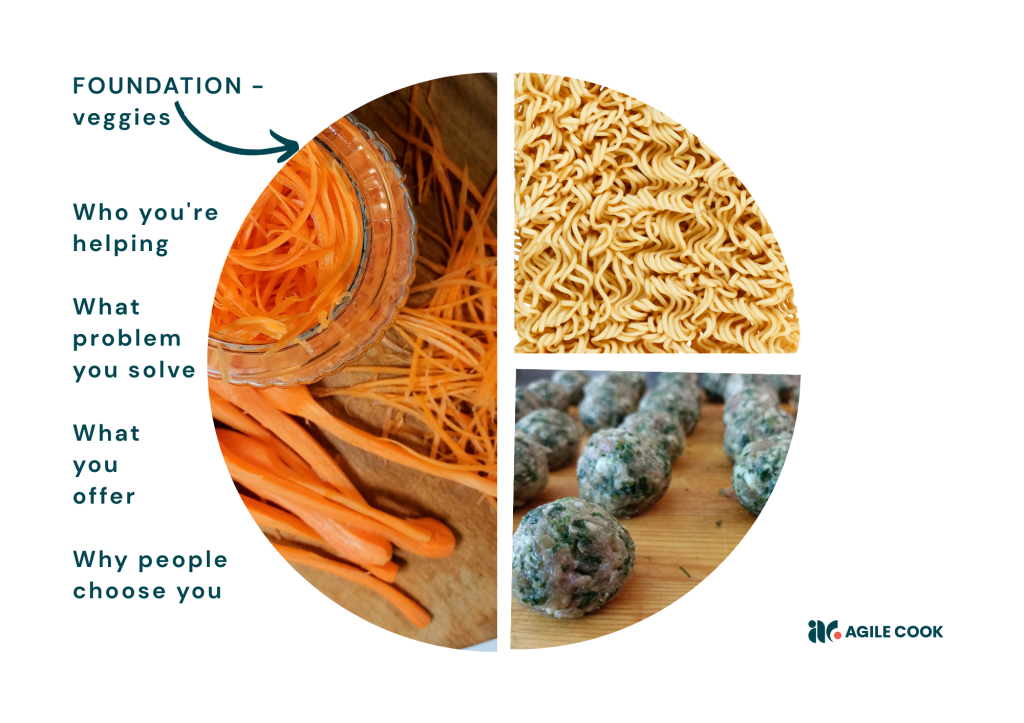
The 6 foundational tools in this layer:
Market Research & Buyer Personas Customer Journey Mapping Segmentation, Targeting & Positioning (STP) Value Proposition Canvas Product / Service Definition Customer Feedback & Adaptation
Your veggies may be weak if:
- You get traffic, but conversion is poor
- Different people in the team describe the company differently
- Your homepage sounds broad, polite, and interchangeable
- Sales calls begin with basic confusion
- You keep attracting the wrong type of lead
What to ask your team
- Who is our best-fit customer, really?
- What problem do they believe they are solving when they buy from us?
- Which audience segment converts best today?
- What message is landing best, and with whom?
- Where are customers getting confused?
What marketing can realistically deliver here
- Sharper positioning
- Clearer messaging
- Better-fit leads
- Stronger conversion with the right audience
- Better understanding of what customers actually care about
What marketing cannot deliver here
- Instant growth from a vague offer
- Efficient campaigns for a business no one can explain clearly
- Strong demand from the wrong audience
Founder question to keep
Do we have a traffic problem, or a clarity problem?
Proteins = Support
What this part does
This is the muscle behind the strategy.
It includes your CRM, handoff process, tracking, reporting, team roles, follow-up rhythm, and the bridge between marketing and sales.
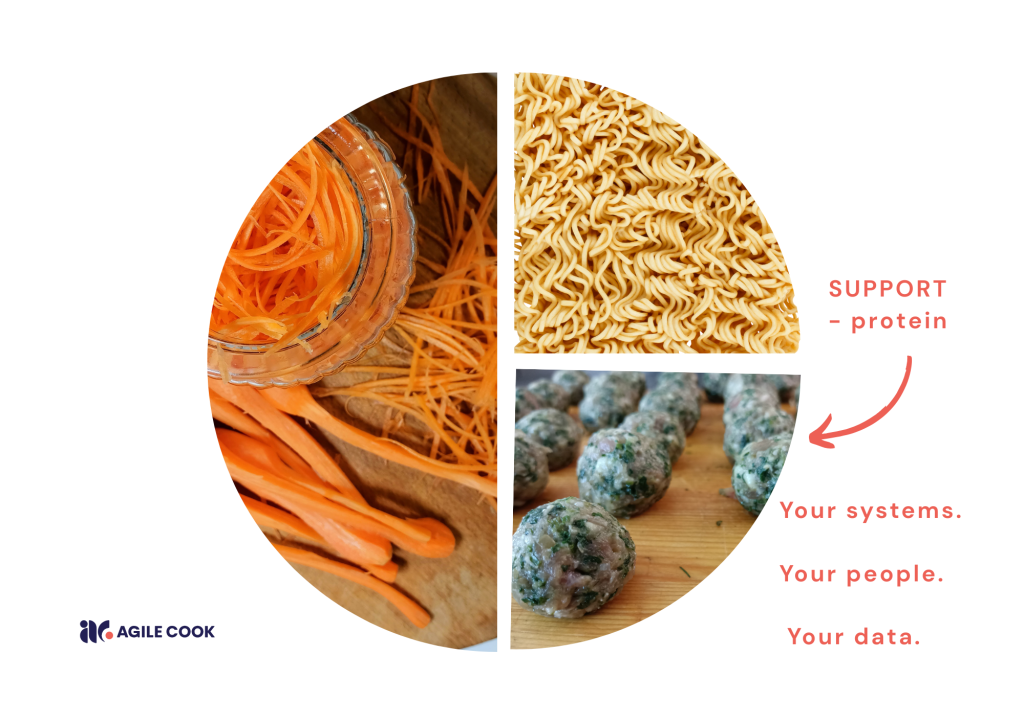
The 5 support tools in this layer:
CRM & Data Infrastructure Team & Organizational Design Physical Evidence Brand Positioning Statement Long-Term Promotion & Loyalty Programs
Your proteins may be weak if:
- Leads come in, but follow-up is slow or inconsistent
- Sales and marketing blame each other
- Reporting is messy or unreliable
- Nobody can tell which leads are actually good
- Marketing is active, but learning is weak
- The founder becomes the human glue between teams
What to ask your team
- Where do leads go after they come in?
- How fast are we following up?
- What counts as a qualified lead?
- Where does the process break most often?
- Can we clearly track what is working and what is not?
What marketing can realistically deliver here
- Better lead handling
- Cleaner handoffs
- More reliable reporting
- Stronger alignment with sales
- More repeatable execution
What marketing cannot deliver here
- Reliable growth on top of broken systems
- Useful insights from messy data
- Strong performance when nobody owns the process
Founder question to keep
Is our marketing weak, or is our system weak?
Carbs = Fuel
What this part does
This is the visible energy.
It is where campaigns happen: SEO, paid media, content distribution, social media, outbound, landing pages, promotions, email, testing.
This is what most people point to when they say, “We need marketing.”

The 6 fuel frameworks in this layer:
SWOT Analysis Porter’s Five Forces AIDA Funnel (Attention → Interest → Desire → Action) RACE Framework (Reach → Act → Convert → Engage) Short-Term Promotions & Campaign Planning Price & Incentives
Your carbs may be weak if:
- There is lots of activity, but little business impact
- Campaigns keep changing without learning
- Traffic is growing, but qualified demand is not
- Acquisition feels expensive and scattered
- The team confuses being busy with making progress
What to ask your team
- Which channel is actually moving the business?
- What are we learning from each campaign?
- Which activities generate qualified demand, not just attention?
- What should move if this is working?
- Are we investing in the right channel for this stage of growth?
What marketing can realistically deliver here
- More visibility
- More traffic
- More tests
- More demand capture
- Faster learning about channels and offers
- Momentum when the foundation is already clear
What marketing cannot deliver here
- Efficient scale if your positioning is weak
- Good leads from a bad offer
- Lasting results from random activity
Founder question to keep
Which channel is creating business movement, not just marketing movement?
Herbs & Spices = Differentiation
What this part does
This is what makes the business memorable.
Your tone of voice.
Your story.
Your proof.
Your point of view.
Your customer experience.
The details that make people remember you and feel more certain choosing you.

The 6 differentiation levers in this layer:
Ansoff Matrix IMC (Integrated Marketing Communications) Experiential & Event Marketing Content Marketing & Storytelling Digital Channels & Automation Personalization & Loyalty Enhancements
Your herbs and spices may be weak if:
- Your company sounds like everyone else in the category
- People compare you mostly on price
- Referrals are weak
- Customers say “interesting,” but do not move
- You get attention, but not trust
- Your brand feels technically correct and emotionally forgettable
What to ask your team
- What makes us easier to choose, not just easier to find?
- Why do customers remember us?
- What proof do we have that builds trust?
- What is distinct in how we show up?
- Where are we still sounding generic?
What marketing can realistically deliver here
- Stronger memorability
- Better trust signals
- A clearer brand story
- More distinct positioning in the mind of the customer
- Better conditions for referral and repeat attention
What marketing cannot deliver here
- Magic differentiation without a real point of difference
- Premium perception on top of weak delivery
- Strong trust if the experience does not back up the story
Founder question to keep
What makes us easier to choose, not just easier to notice?
What founders should ask before approving more marketing work
Before saying yes to a new agency, a new campaign, or a new content plan, ask these five questions:
1. What is marketing solving right now?
Not in general. Not forever. Right now.
2. Which part of the plate is weakest?
Foundation, support, fuel, or differentiation?
3. What should move if this is working?
Not a vague feeling. A real signal.
4. What can marketing influence directly?
And what depends on product, sales, or operations too?
5. What is a realistic timeline?
Because not all marketing works on the same clock.
That one habit alone will save a founder from a lot of expensive wandering.
What founders should realistically expect from marketing
This part matters because many founder frustrations come from expecting marketing to deliver the wrong thing at the wrong time.
A good marketing function should help you get:
Clearer customer understanding
Who is buying, why they buy, what objections keep showing up, and what messages work best.
Sharper positioning
A more believable, more relevant answer to why this company matters to this customer.
Better decisions
Which channels deserve investment, which offers are working, where friction sits, and what is worth fixing first.
More efficient execution
Better handoffs, cleaner campaigns, stronger conversion paths, less random activity.
Better growth conditions
Not guaranteed scale.
Not miracle results.
Better odds.
Marketing should make the business easier to understand, easier to trust, and easier to choose.
That is already a big job.
What founders should not expect from marketing
Marketing is powerful, but it is not a rescue blanket for every business problem.
It cannot create product-market fit from thin air.
It cannot permanently compensate for poor delivery.
It cannot fix a broken sales process with better copy.
It cannot save a vague offer by posting more often.
Marketing amplifies what is already there.
That can be very good news.
Or very awkward news.
A light note on investor metrics
It helps founders to know that investors do not just look for activity. They look for signs that growth is efficient, believable, and supported by healthy economics.
But that deserves its own article that will soon come.
This one is about something more immediate:
Helping founders judge what marketing should do, what marketing can influence, and what expectations make sense before the investor conversation even starts.
A simple founder recipe
If you want to use this in a real meeting, do this:
Pick one business priority for the next 90 days.
Not six. One.
Then ask:
- What part of the plate is weakest right now?
- What is marketing solving?
- What should move if this is working?
- What can marketing influence directly?
- What depends on product, sales, or operations too?
- What is realistic to expect in this timeframe?
That is a much better conversation than:
“Should we post more on LinkedIn?”
Final thought
Founders do not need to become experts in SEO, paid media, social media, analytics, conversion, brand, and lifecycle marketing just to survive a marketing meeting.
They need a way to tell the difference between activity and progress.
That is what the Marketing Plate is for.
Not to make marketing sound clever.
To make it easier to diagnose.
Because most startups do not need more tactics first.
They need to know whether the real problem is weak veggies, shaky proteins, tired carbs, or forgettable spices.
And once that becomes clear, marketing gets much easier to judge and much more useful to lead.
Not sure which part of your Marketing Plate is holding growth back?
Let’s start there. Contact me for a personalized diagnosis and we’ll look together at what your marketing should do, what it can realistically improve, and where your business actually needs attention first.

Elena
Marketing Strategist · The Agile Cook
I help startup founders and entrepreneurs cut through marketing noise and build strategies that actually grow businesses. The Marketing Plate is my framework for making complex marketing decisions simple, practical, and honest. Based in Transylvania. Available for consulting, workshops, and founder diagnostics. elena@theagilecook.com
 Marketing, made clear
Lasă un comentariu