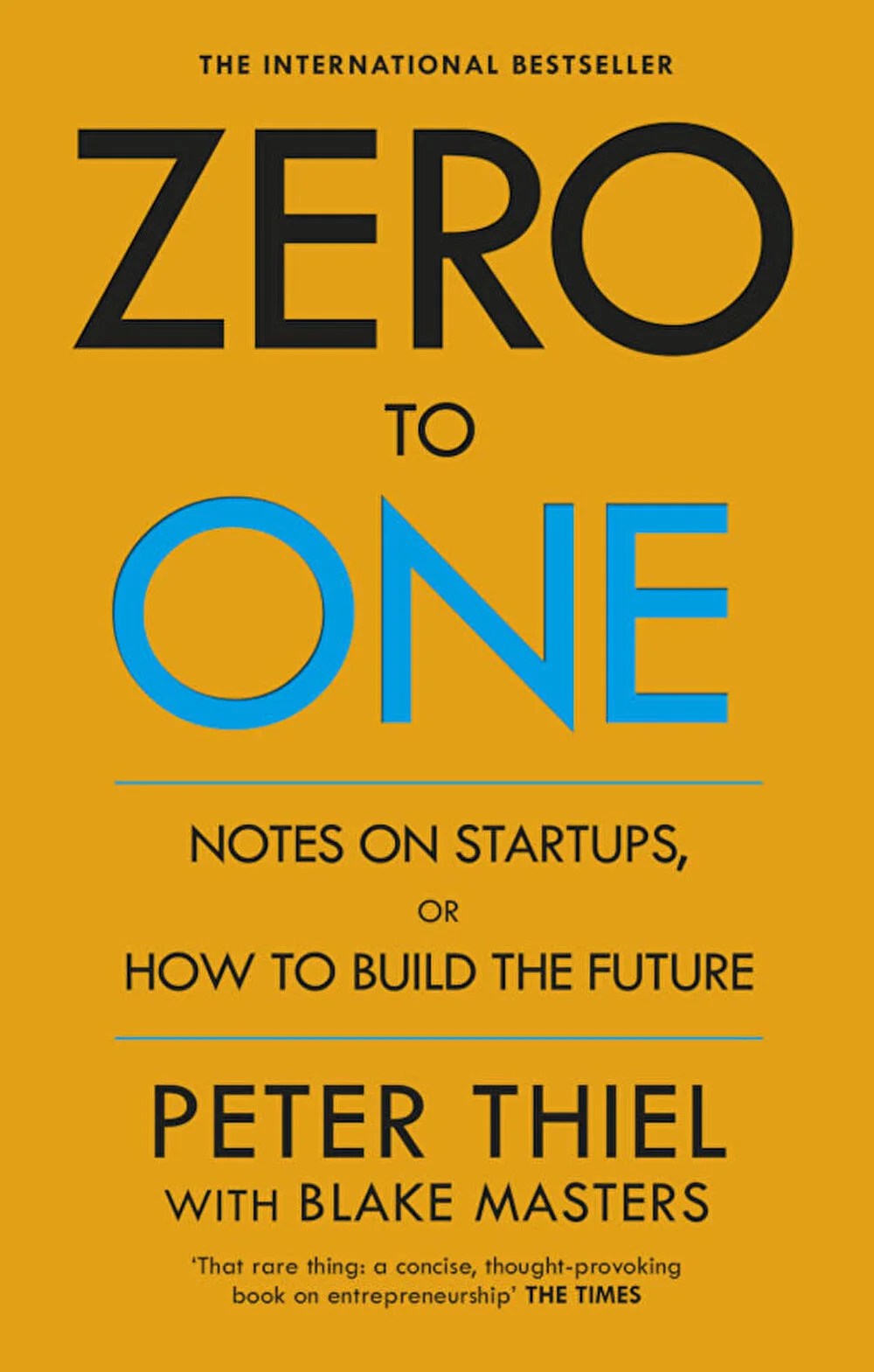
Zero to One. Notes on Startups or How to Build the Future by Peter Thiel with Blake Masters.
If handier, click on the link to listen to the recording:
The book is based on a course about startups that Thiel taught at Stanford in 2012. The idea behind 0 to 1 is to build companies that create new things.
Why? Because every moment in business happens only once. Unless your company will invest in creating new things, it will fail in the future, no matter how big your profits are now.
Peter Thiel, Zero to One. Notes on Startups or How to Build the Future
The next Bill Gates will not build an operating system. Today’s „best practices” lead to dead ends; the best paths are new and untried, writes Peter Theil. It’s easier indeed, to copy a model than to make something new but he warns that on long term copying or implementing successful recipes takes us nowhere.
Here’s my highlights on each chapter, a quick glimpse on the things I’ve found inspiring and worth thinking of:
1. The Challenge of the Future: what’s your answer to the contrarian*
question: „What important truth do very few people agree with you?”
A good answer sound like this: „Most people believe in X, but the truth is opposite to X.” Possible answers are actually different ways of seeing the present. A good answer is a bit like a SF scenario, or as close as we can come to looking into the future.
Too much theory? Don’t worry, I come with the example, Thiel’s answer: „Most people think the future of the world will be defined by globalization, but the truth is that technology matters more.” You remember the principle of globalization: copying things that work in a country and making them work everywhere. But imagine if all the millions of households in India were to live the way Americans already do, the result would be environmentally catastrophic. Spreading old ways to create wealth around the world will result in devastation, not riches. In a world of scarce resources, globalization without new technology is unsustainable.
New technology tends to come from new ventures, startups, and a startup has to question received ideas and rethink business from scratch. A new company’s most important strengths in new thinking.
Peter Thiel, Zero to One. Notes on Startups or How to Build the Future
*a contrarian is a person who holds a contrary position, especially a position against the majority, challenges or rejects the conventional consensus, making counterintuitive claims, attacking what is said to be the the conventional wisdom. Source: wikipedia.org
2. Party Like it’s 1999 or ask yourself: What does everybody agree on?
If you can spot a popular misconception, you’ll find the contrarian truth behind it. Peter Thiel gives the ’90 as example: we tend to remember it as a cheerful period, but the reality was quite different, remember? Wall of Berlin falls, United States was in recession, the war of Somalia, anxiety about globalisation as US jobs started to be outsourced to other countries. The cultural fascinations were Nirvana, grunge, heroin addiction, not quite hope and confidence.
And then the internet comes and changes everything: in 1993, with the launch of the first browser, regular people can now get online. Mosaic soon becomes Netscape and by the end of ’85 company’s stock grows in five months from 28 USD to 174 USD per share. Yahoo! goes public in 1996, at 848 million USD value, Amazon comes the next year at 438 million USD. By spring 1998, each company’s stock had more than quadrupled.
But things weren’t going too well in the rest of the World: East Asian financial crisis hit in 1997, Thai, Indonesian and South Korean economies went down. The ruble crisis in Russia, Europe wasn’t quite well either after the Euro launched in January 1999.
The Old Economy couldn’t handle globalisation and something needed to work, so the New Economy of the internet was the only way forward.
September 1998 – March 2000 are called the dot-com mania, 18 months of insanity: money was everywhere in Silicon Valley. People were leaving their well paid jobs to fund or join startups and were throwing extravagant launching parties. Sometimes thousand dollar dinner bills were „paid” with shares in these startups. But in spring 2002, the bubble popped, the ’90s migration „from bricks to clicks” didn’t work as hoped, and the investors went back to bricks (housing) and globalisation. The result was another bubble, this time in real estate.
Lessons learned by the Sillicon Valley entrepreneurs:
- Make incremental advances: small steps are the only safe path forward.
- Stay lean and flexible: don’t plan that much and treat entrepreneurship as agnostic experimentation.
- Improve on the competition: the only way to know you have a real business is to start with an already existing customer. Build your company by improving recognizable products already offered by successful competitors.
- Focus on product, not sales: the only sustainable growth is viral growth.
And yet, the opposite principles are probably more correct:
- It is better to risk boldness than triviality
- A bad plan is better than no plan
- Competitive markets destroy profits
- Sales matters as much as the product
There was indeed a bubble of technology, but we still need new technology. The most contrarian thing of all is not to oppose the crowd but to think for yourself
3. All Happy Companies are Different, ask yourself: What valuable company is nobody building?
The airlines compete with each other, but Google stands alone. We can call this perfect competition versus monopoly. If we have on the market too many similar companies, they’ll suffer losses, some will collapse and prices will rise back to unsustainable levels. Under perfect competition, no company makes economic profit on the long run. The opposite of perfect competition is monopoly. By „monopoly”, Thiel describes the kind of company that’s so good at what it does that no other firm can offer a close substitute. If you want to create and capture lasting value, don’t build an undifferentiated commodity business. The biggest mistake a startup can make is to understate the scale of competition.
Monopolists can afford to think at other things than making money, monopoly is the condition of every successful business. Remember how Tolstoy opens Anna Karenina by observing: „All happy families are alike; each unhappy family is unhappy in its own way.”?Business are the opposite: all happy companies are different: each one earns a monopoly by solving a unique problem. All failed companies are the same: they failed to escape competition.
4. The Ideology of Competition: the more we compete, the less we gain
Even our educational system drives and reflects our obsession with competition. But why do people compete with each other? The author goes back to Marx and Shakespeare’s models of conflict to illustrate his view on competition. According to Marx, people fight because they are different. The proletariat fights the bourgeoisie because they have completely different ideas and goals (generated by their very different material circumstances). The grater the differences, the greater the conflict. To Shakespeare, by contrast, all combatants look more or less alike. It’s not at all clear why they should be fighting since they have nothing to fight about. The two houses are alike, yet they hate each other. In the world of business, Shakespeare proves the superior guide. Competition can make people hallucinate opportunities where none exists. Companies become obsessed with defeating its rivals, precisely because there were no substantive differences to focus on.
For Hamlet, greatness means willingness to fight for reasons as thin as an eggshell: anyone would fight for things that matter; true, but heroes take their personal honor so seriously they will fight for things that don’t matter. If you can recognize a competition as a destructive force instead of a sign of value, you’re already more sane than most.
5. Last Mover Advantage: how to use a clear head to build a monopoly business
Escaping competition will give you a monopoly, but even a monopoly is only a great business if it can endure in the future. The value of a business today is the sum of all the money it will make in the future. An Old Economy business, like a newspaper, might hold its value if it can maintain its current cash flows for five or six years. Technology companies, New Economy, follow the opposite trajectory: they often lose money for the first years, it takes time to build valuable things, and that means delayed revenue. Most of a tech company’s value will come at least 10 to 15 years in the future.
Here are Peter Thiel’s Characteristics of Monopoly
- Proprietary Technology: once you’re 10 times better, you escape competition. Google’s search algorithms return results better than anyone else’s. Proprietary technology must be at last 10 times better than its closest substitute in some important dimension to lead to a real monopolistic advantage. Anything less will be perceived as a marginal improvement and be hard to sell, especially in an already crowded market. You can also make a 10x improvement through superior integrated design.
- Network Effects: make a product more useful as more people use it. The key is that your product is valuable to its very first users when the network is necessarily small. The initial markets are so small that they often don’t even appear to be business opportunities at all.
- Economies of scale: a monopoly business gets stronger as it gets bigger: the fixed costs of creating a product (engineering, management, office space) can be spread out over greater quantities of sales. A good startup should have the potential for great scale built into its first design.
- Branding: a company has a monopoly on its own brand by definition, so creating a strong brand is a powerful way to claim a monopoly.
Building a Monopoly
Start Small and Monopolize: the perfect target market for a startup is a small group of particular people concentrated together and served by few or no competitors.
Scaling Up: once you create and dominate a niche market, then you should gradually expand into related and slightly broader markets. Eg: Amazon had some of the most rarely sold books, those least profitable for any retail store to keep in stock, so drew the most enthusiastic customers. It worked well for intense interest groups.
Don’t disrupt: „disruption” was originally a term of art to describe how a firm can use new technology to introduce a low-end product at low prices, improve the product over time, and eventually overtake even the premium products offered by incumbent companies using older technology. As you craft a plan to expand to adjacent markets, don’t disrupt: avoid competition as much as possible.
The Last will be First
You’ve probably heard about „first mover advantage”, but moving first is a tactic, not a goal. It’s much better to be the last mover – that is, to make the last great development in a specific market and enjoy years or even decades of monopoly profits. Like in chess, „you must study the endgame before everything else.”
6. You Are Not a Lottery Ticket: success is never accidental
Thiel thinks one can expect the future be definite or indefinite and better or worse than the present. These four possibilities generate four possible views of the future:
- Indefinite pessimism: an indefinite pessimist looks out onto a bleak future but has no idea what to do with it
- Definite pessimism: one thinks the future can be known, but since it will be austere, we must prepare for it
- Definite optimism: the future will be better than the present if he plans and works to make it better. As Marx and Engels saw clearly, the 19th century business class created the more massive and colossal productive forces than all preceding generations together: machinery, railways, telegraphs etc
- Indefinite optimism: the future will be better, but he doesn’t know how exactly, so he won’t make any specific plans. He expects to profit from the future but he sees no reason to design it concretely. Like boomers, a whole generation who learned from childhood to overrate the power of chance and to underrate the importance of planning. While a definitely optimistic future would need engineers to design underwater cities and settlements in space, an indefinitely optimistic future calls for more bankers and lawyers. Finance represents indefinite thinking because it’s the only way to make money when you have no idea how to create wealth.
The author thinks definite optimism works when you built the future you envision. Definite pessimism works by building what can be copied without expecting anything new. Indefinite pessimism works because it’s self-fulfilling: if you’re a slacker with low expectations, the’ll probably be met. But indefinite optimism seems inherently unsustainable: how can the future get better if no one plans for it? Thiel closes this chapter stating we have to find our way back to a definite future. A startup is the largest endeavour over which you can have definite mastery. You can have agency not just over your own life, but over a small and important part of the world. It begins by rejecting the unjust tyranny of Chance. You are not a lottery ticket.
7. Follow the Money: the best investment in a successful fund equals or outperforms the entire rest of the fund combined.
We don’t live in a normal world; we live under a power law. In 1906, economist Vilfredo Pareto discovered the 80-20 rule, when he noticed that 20% of the people owned 80% of the land in Italy, a phenomenon that he found just as natural as the fact that 20% of the pea pods in his garden produced 80% of the peas.
Peter Thiel thinks even seasoned investors understand this phenomenon only superficially. They know companies are different, but they underestimate the degree of difference. The error is expecting venture reports to be normally distributed: that is, bad companies will fail, mediocre will stay flat, and good ones will return 2x or even 4x. Assuming this, investors assemble a diversified portfolio and hope winners will counterbalance losers. Unfortunately this „spray and pray” approach usually produces an entire portfolio of flops, because venture returns don’t follow a normal distribution overall. They follow power law: a small handful of companies radically outperform all others. If you focus on diversification instead of single-minded pursuit of the very few companies that can become overwhelmingly valuable, you’ll miss those rare companies in the first place. He gives a personal example, from Founders Fund, where their investment in Facebook returned more than all the others combined. Same with Palantir, their second best investment, is set to return more than the sum of every other investment aside from Facebook.
The biggest secret in venture capital is that the best investment in a successful fund equals or outperforms the entire rest of the fund combined. This implies two very strange rules:
- Only invest in companies that have the potential to return the value of the entire fund. It’s scary, as it eliminates the vast majority of possible investments.
- Because rule 1. is so restrictive, there can’t be any other rules.
People usually spend more time on the most problematic companies than they do on the most obviously successful, missing the big picture. You should focus on something you’re good at doing, but before that you must think hard if it will be valuable in the future.
8. Secrets: every great business is built around a secret that’s hidden from the outside.
Every one of today’s most famous and familiars ideas was once unknown and unsuspected, today they became conventions. A conventional truth can be important, it’s essential to learn elementary maths, but it won’t give you an edge. It’s not a secret, remember: what important truth do very few people agree with you on? Our society came to believe that there are no hard secrets left, in a time when unknown seems less accessible than ever. Parents don’t expect their kids to be explorers anymore. From an early age we are taught that the right way to do things is through small steps, day by day, grade by grade. If you overachieve and learn something that’s not on the test, you won’t receive credit for it. But in exchange for doing exactly what’s asked of you, you get an A. Secondly, there’s risk aversion: people are scared of secrets because they are scared of being wrong. If your goal is to never make a mistake in your life, then you shouldn’t look for secrets.
In economics, disbelief in secrets lead to faith in efficient markets. But the existence of financial bubbles shows that markets can have extraordinary inefficiencies; the more people believe in efficiency, the bigger the bubbles get.
So, when thinking about what kind of company to build, ask yourself: What secrets is nature not telling you and what secrets are people not telling you? Every great business is built around a secret that’s hidden from the outside. A great company is a conspiracy to change the world!
9. Foundations: „a startup messed up at its foundation cannot be fixed”, Thiel’s law
Get the first things right: ownership (who legally owns a company’s equity), possession (who actually runs the company on a day-to-day basis) and control (who formally governs the company’s affairs?). Most conflicts in startups occur between ownership and control, between founders and investors on the board. In the boardroom, less is more and a board of three is ideal. When unsavvy observers see a nonprofit organisation with dozens of people on its board, they think: „Look how many great people are committed to this organisation! It must be extremely well run!” In reality a huge board will exercise no efficient oversight at all; it merely provides cover for whatever micro dictator actually runs the organisation.
Cash is not not the king, however, high cash compensation teaches workers to claim value from the company as it already exists instead of investing their time to create new value in the future.
The most valuable kind of company maintains an openness to invention that is most characteristic of beginning. If you get the founding moment right, you can do more than create a valuable company, you can steer its distant future toward the creation of new things instead of the stewardship of inherited success.
10. The Mechanics of Mafia: best startups might be considered slightly less extreme kind of cults
You can’t accomplish anything meaningful by hiring an interior decorator to „beautify” your office, „a human resources” consultant to fix your policies, or a branding specialist to hone your buzzwords. „Company culture” doesn’t exist apart from the company itself. No company has a culture; every company is a culture.
„From the start, I wanted PayPal to be tightly knit instead of transactional. I thought stronger relationships would make us not just happier and better at work, but also more successful in our careers even beyond PayPal. So we set out to hire people who would actually enjoy working together. They had to be talented, but above that, they had to be excited about working specifically with us. That was the start of the PayPal Mafia.”
Recruiting is a core competency for any company, it should never be outsourced. Questions to think about:
Why would someone join your company as its 20th engineer when she could go to work at Google for more money and more prestige?
Why are you doing something important that no one else is going to get done?
In PayPal Mafia, they all loved SF and were obsessed with creating a digital currency that could be controlled by individuals instead of governments.
11. If You Build It, Will They Come? Poor sales rather than bad product is the most common cause of failure.
Advertising matters because it works, but only when your customer acquisition cost and customer lifetime value make every other distribution channel uneconomical.
If you’ve invented something new but you haven’t invented an effective way to sell it, you have a bad business – no matter how good the product. Superior sales and distribution by itself can create a monopoly, even with no product differentiation.
Complex sales works best when you don’t have „salesmen” at all. In Palantir, his data analytics company, the co-founder Alex Karp is doing the sales. At that price point, buyers want to talk to the CEO, not the VP of sales.
Thiel also considers a product is viral if its core functionality encourages users to invite their friends to become users too, the Facebook and PayPal model. Get the most valuable users first!
12. Man and Machine: computers are tools, not rivals. Ask yourself: how can computers help humans solve hard problems?
The difference between man and machine is that gains from working with computers are much higher that gains from trade with other people.
Better technology in law, medicine and education won’t replace professionals, it will allow them to do even more. LinkedIn set out to transform how recruiters did their jobs.
13. Seeing Green: The 7 questions that every business must answer – get them right!
- The Engineering Question: Can you create breakthrough technology instead of incremental improvements? Only when your product is 10x better you can offer the customer transparent superiority.
- The Timing Question: Is now the right time to start your particular business?
- The Monopoly Question: Are you starting with a big share of a small market?
- The People Question: Do you have the right team?
- The Distribution Question: Do you have a way to not just create but deliver your product?
- The Durability Question: Will your market position be defensible 10 and 20 years into the future? Ask yourself: what would stop China from wiping out my business?
- The Secret Question: Have you identified a unique opportunity that others don’t see?
Doing something different is what’s truly good for society – and it’s also what allows a business to profit by monopolising a new market. The best projects are likely to be overlooked, not trumpeted by a crowd; the best problems to work are often the ones nobody else even tries to solve.
14. The Founder’s Paradox
Don’t overestimate your own power as an individual. Founders are important because a great founder can bring out the best work from everybody at his company.
The single greatest danger for a founder is to become so certain of his own myth that he loses his mind.
 Marketing, made clear
Lasă un comentariu